
Use these loans to meet emergency needs, and not to fund holidays or luxury purchases.

The more things change, the more they remain the same for corporate India. In the April-June 2025 period (Q1FY26) - for the ninth consecutive quarter - listed companies witnessed only single-digit revenue growth, while their core earnings, excluding other income and one-time gains, contracted for the second time in four quarters. This comes as firms brace for the impact of 50 per cent US tariff on Indian goods.

From the Sensex pack, Tata Steel, Zomato, Power Grid, UltraTech Cement, IndusInd Bank, Larsen & Toubro, Adani Ports, NTPC, State Bank of India and Reliance Industries were among the major gainers. On the other hand, Tech Mahindra, Tata Consultancy Services, ITC, Infosys, Sun Pharma, Maruti, HCL Tech, and Nestle were among the laggards.

Finance Minister Nirmala Sitharaman on Tuesday asked fintech firms to focus on risk management at a time when criminals are using AI to mimic voices, clone identities and create lifelike videos to manipulate people.

Among Sensex firms, Tata Steel jumped the most by 5.90 per cent. Titan, Mahindra & Mahindra, ITC, Eternal, State Bank of India, and Trent were among the other gainers. However, Infosys, NTPC, Hindustan Unilever, TCS, Adani Ports and Bharti Airtel were among the laggards.

State Bank of India has 18,000 pending cases and Bank of Baroda has around 1,000 cases.

Fitch Ratings has removed energy infrastructure company Adani Energy Solutions Ltd (AESL) from its 'Ratings Watch Negative' list, the first upgrade by an international ratings agency since the US indictment. Fitch affirmed AESL long-term foreign and local-currency issuer default ratings (IDRs) at 'BBB-'.

India Ratings on Thursday said that any broad-based or strong recovery in corporate capital expenditure was unlikely in the upcoming financial year 2026 (FY26) due to uncertainty of domestic and external demand. The uncertainty is adversely affecting the overall corporate sector capex. Interest rates on credit are not the primary deterrent to decisions about capital expenditure, said Soumyajit Niyogi, director, core analytical group, Ind-Ra, in a webinar on the credit market outlook.

'Maintain a balanced approach with a preference for short-to medium-duration funds.'

'In this age of competition, we will not survive long if we do not provide quality service to our consumers'

In a first, the Reserve Bank of India (RBI) has announced that it will conduct daily variable rate repo (VRR) auctions on all working days in Mumbai, until further notice. The daily auctions, aimed at easing the current liquidity tightness in the banking system, will begin on Friday, with a notified amount of Rs 50,000 crore.

The Reserve Bank of India (RBI) has extended the trading hours for the interbank call money market from July 1, and that of repo and tri-party repo markets from August 1. Market participants said the decision is intended to help reduce the large Standing Deposit Facility (SDF) balances held by banks with the RBI, thereby addressing liquidity mismatches.

As the rally in precious metals takes centre stage in 2025, most analysts recommend a larger allocation to gold over silver despite the latter's outperformance this year. In the current calendar year (CY25), spot gold prices in dollar terms rallied

Actor Sonu Sood was questioned by the Enforcement Directorate (ED) in connection with a money-laundering case linked to the online betting app 1xBet. The investigation involves several celebrities and focuses on alleged tax evasion and the duping of individuals.

Gold prices surged Rs 2,200 to hit a fresh peak of Rs 116,200 per 10 grams in the national capital on Monday buoyed by strong global cues as investors awaited key commentary from US Fed officials for policy direction. According to the All India Sarafa Association, the precious metal of 99.9 per cent purity had closed at Rs 1,14,000 per 10 grams on Friday.

The World Bank on Wednesday lowered India's growth forecast for the current fiscal by 4 percentage points to 6.3 per cent amid global economic weakness and policy uncertainty. In its previous estimate, the World Bank had projected India's growth at 6.7 per cent for the fiscal year 2025-26.

Banks are set to make treasury gains in the fourth quarter of the current financial year (2024-25) as the yield on government bonds has softened so far this quarter, driven by strong inflows into the debt segment, market participants said. The yield on the 10-year benchmark government bond fell 8 basis points (bps) in the previous week - the steepest weekly decline in four months, since November 30, 2024 - to settle at 6.62 per cent.

GST 2.0 may cushion consumers against US tariffs, but like the 2019 corporate tax cut, it risks being another tactical fix rather than a structural growth strategy, expects Debashis Basu.

Union Finance Minister Nirmala Sitharaman on Monday said people are finding current interest rates "very stressful" and urged banks to make them affordable. Speaking at an event organised by State Bank of India, the finance minister said that at present, India requires industry to ramp up and invest in new facilities, and added that lowering lending rates can help achieve the "Viksit Bharat" aspiration.

The Enforcement Directorate questioned Robin Uthappa for over eight hours and recorded his statement in a money laundering case linked to online betting app.

Pakistan beat Bangladesh, set up first ever Asia Cup final date against India

Banks recorded a higher growth year-on-year (Y-o-Y) in raising deposits during the second quarter of financial year 2025 (Q2FY25) compared to Q1FY25, owing to intensified efforts to raise liabilities by offering higher rates and innovative schemes.

'It was like rigorously preparing for a solid, good exam...' 'I don't know what marks I will get, but I felt the rigorous preparation of an exam.' 'You may sweat, but I feel rejuvenated.'

Borrowers should consider switching from an MCLR-linked to a repo rate-linked loan.

Ask rediffGURU and PF, MF and insurance expert Purshotam Lal your mutual fund, insurance and personal finance-related questions.
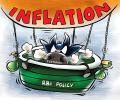
Retail inflation slipped to seven-month low of 3.61 per cent in February mainly due to easing prices of vegetables, eggs, and other protein-rich items, creating space for the RBI to go for another cut in interest rate next month.

Women's World Cup winner Divya Deshmukh, who has also qualified for the Women's Candidates, has opted out of the women's section to compete with the best in business.

'I realised why the farmers and the rural folks are going for Trump. They are so insecure and vulnerable that anybody who is throwing a line of hope to them, they seize it.'

Yuvraj Singh on Tuesday appeared before the Enforcement Directorate (ED) for questioning in a money laundering case linked to an online betting app named 1xBet.

Foreign investors offloaded Indian equities worth nearly Rs 21,000 crore in the first half of August, pressured by US-India trade tensions, lacklustre first-quarter corporate earnings, and a weakening rupee.

As a protege of Shinzo Abe, Takaichi is expected to scale bilateral ties much higher. Trade and investment shall grow. People-to-people contacts shall be scaled up, points out Dr Rajaram Panda.

The Indian services sector growth touched an 11 month high in July, supported by a pickup in new exports orders and sharp rise in overall sales, a monthly survey said on Tuesday. The seasonally adjusted HSBC India Services PMI Business Activity Index was at 60.5 in July, little-changed from 60.4 in June, and the rate of expansion was the best seen since August 2024.

Dr Nagesh Kumar, one of the three new MPC members, wanted the MPC to reduce the repo rate by 25 basis points to 6.25%.

Owing to uncertainties on higher inflation and muted growth in the United States (US), coupled with concerns around America's rising debt and tariffs imposed by President Donald Trump, the world's largest economy has become the epicentre of an unabated record rally in prices of precious metals.

"We currently manage collections for over 98 million retail and small-business loan accounts, covering a loan book of about $250 billion," says Rishabh Goel, cofounder and chief executive officer (CEO) of Credgenics, a software-as-a-service platform for debt collection. With more than 700 million smartphone users and over 450 million UPI users, digital access is everywhere.

In trade negotiations, as in chess, sometimes you need to accept a temporary disadvantage to secure a better long-term position, points out Sonal Varma, chief economist (India and Asia ex-Japan) at Nomura.

Among Sensex firms, NTPC, Axis Bank, Power Grid, Bharti Airtel, Eternal and Sun Pharma were the major gainers. However, Infosys, Titan, UltraTech Cement and Hindustan Unilever were among the laggards.

India is set to become the world's fourth-largest economy in 2025, but slow income growth, lack of structural change, and rising inequality highlight the gap between progress and real transformation.
ICICI Bank, the second-largest private sector lender and state-owned Indian Bank on Monday raised their lending rates across all tenors in anticipation of a rate hike by the RBI later this week. The rates have been increased across all tenors under the marginal cost of funds-based lending rate (MCLR) system, a move that will make EMIs expensive for those who availed loans benchmarked against the MCLR. Under the revised rates, effective August 1, ICICI Bank's one-year MCLR has increased by 15 basis points or 0.15 per cent to 7.90 per cent, while the overnight MCLR rose to 7.65 per cent, as per information posted on the bank's website.

India's economy is expected to grow 6.4-6.7 per cent during the current financial year driven by strong domestic demand, even as geopolitical uncertainty poses downside risks, the newly appointed CII president Rajiv Memani said on Thursday.
 © 2026 Rediff.com - Advertise with us - Disclaimer - Privacy Policy - Sitemap - Feedback - About us - Terms of use - Grievances